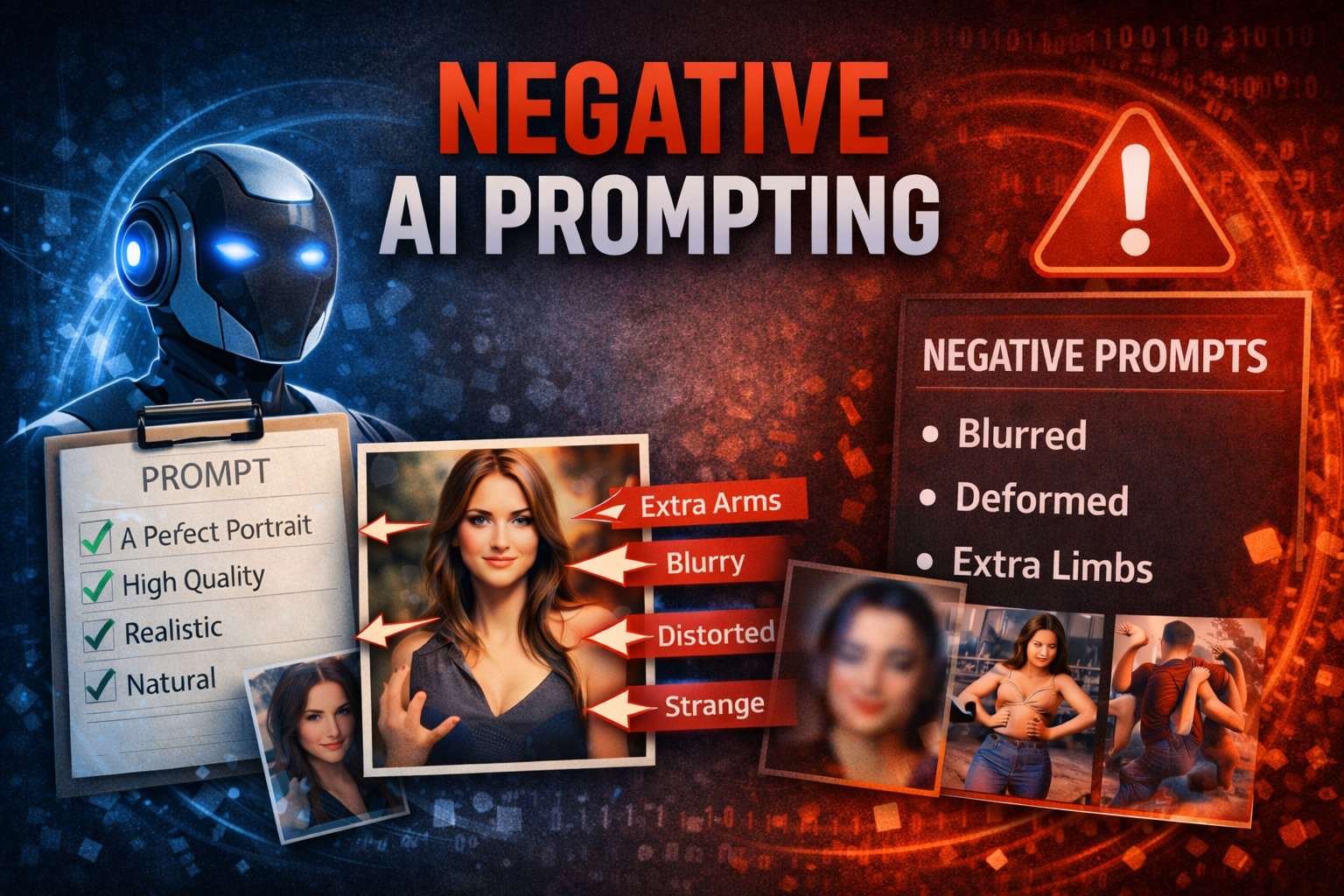
Negative AI Prompting: What It Is, Why It Matters, and How to Use It Effectively
Artificial Intelligence image and text generators have become incredibly powerful. With just a few lines of input, you can generate realistic photos, illustrations, articles, code, music, and more. Most people focus heavily on what to ask for in a prompt—but far fewer understand the importance of defining what NOT to generate.
This is where negative AI prompting becomes essential.
In this article, we will explore negative prompting in depth: what it is, why you need it, what happens when you ignore it, and how to apply it correctly in real-world situations.
What Is Negative AI Prompting?
Negative AI prompting is the practice of explicitly telling an AI system which elements, features, styles, or outcomes to avoid during content generation.
Instead of only saying:
Create a realistic photo of a humanYou also specify:
Avoid extra limbs, distorted faces, blurry textures, unrealistic anatomyIn simple terms:
- Positive prompt = What you want
- Negative prompt = What you do NOT want
Negative prompts act as constraints, guiding the model away from undesirable results.
Why Negative Prompting Is Necessary
1. AI Does Not Truly Understand Mistakes
AI models do not understand anatomy, logic, or realism the way humans do. They predict what looks statistically correct, not what is correct.
- Hands may have too many fingers
- Faces may be asymmetrical
- Eyes may look in different directions
- Bodies may merge into backgrounds
Negative prompting compensates for these weaknesses.
2. Training Data Is Imperfect
AI models are trained on massive datasets that include low-quality images, stylized artwork, warped perspectives, and mistakes. Without guidance, those flaws may reappear in generated content.
3. Default Generation Is Often Too Creative
Creativity is powerful—but sometimes you need precision.
- Product photos need realism
- Medical images need accuracy
- Corporate visuals need professionalism
Negative prompts reduce unwanted creativity.
What Happens Without Negative Prompts?
Visual Problems
- Extra arms, legs, or fingers
- Melting faces
- Floating objects
- Unrealistic lighting
Style Problems
- Cartoon output instead of realism
- Overdone artistic effects
- Wrong color palettes
Content Problems
- Repetitive text
- Hallucinated facts
- Unwanted topics
Common Types of Negative Prompts
Anatomy and Body Structure
extra fingers, extra limbs, malformed hands, distorted face, asymmetrical eyesImage Quality Issues
blurry, low resolution, pixelated, noise, grain, jpeg artifactsStyle Control
cartoon, anime, illustration, painting, sketchLighting and Exposure
overexposed, underexposed, harsh shadows, flat lightingComposition Problems
cropped head, cut-off limbs, cluttered backgroundNegative Prompting for Text-Based AI
Blog Writing Example
Positive:
Write a blog post about WordPress securityNegative:
Avoid basic explanations, avoid marketing language, avoid repetitionCode Generation Example
Negative prompt:
Do not use deprecated functions, avoid inline JavaScript, avoid global variablesWhen Negative Prompting Is Critical
- Realistic human images
- Product photography
- Medical or technical content
- Corporate branding
- Batch generation workflows
How to Write Effective Negative Prompts
Be Specific
extra fingers, twisted wrists, malformed handsGroup Related Issues
blurry, pixelated, low resolution, noiseAvoid Overuse
Too many restrictions can limit creativity and cause unnatural results.
Negative Prompting Is Not Cheating
Negative prompting is simply clear communication. Just like giving precise instructions to a designer or developer, it helps AI deliver professional-quality results.Final Thoughts
Negative AI prompting is one of the most overlooked yet powerful techniques in AI generation.
- Higher realism
- More consistency
- Fewer errors
- Professional output
If you want better AI results, start thinking not only about what you want—but also about what you want to avoid.