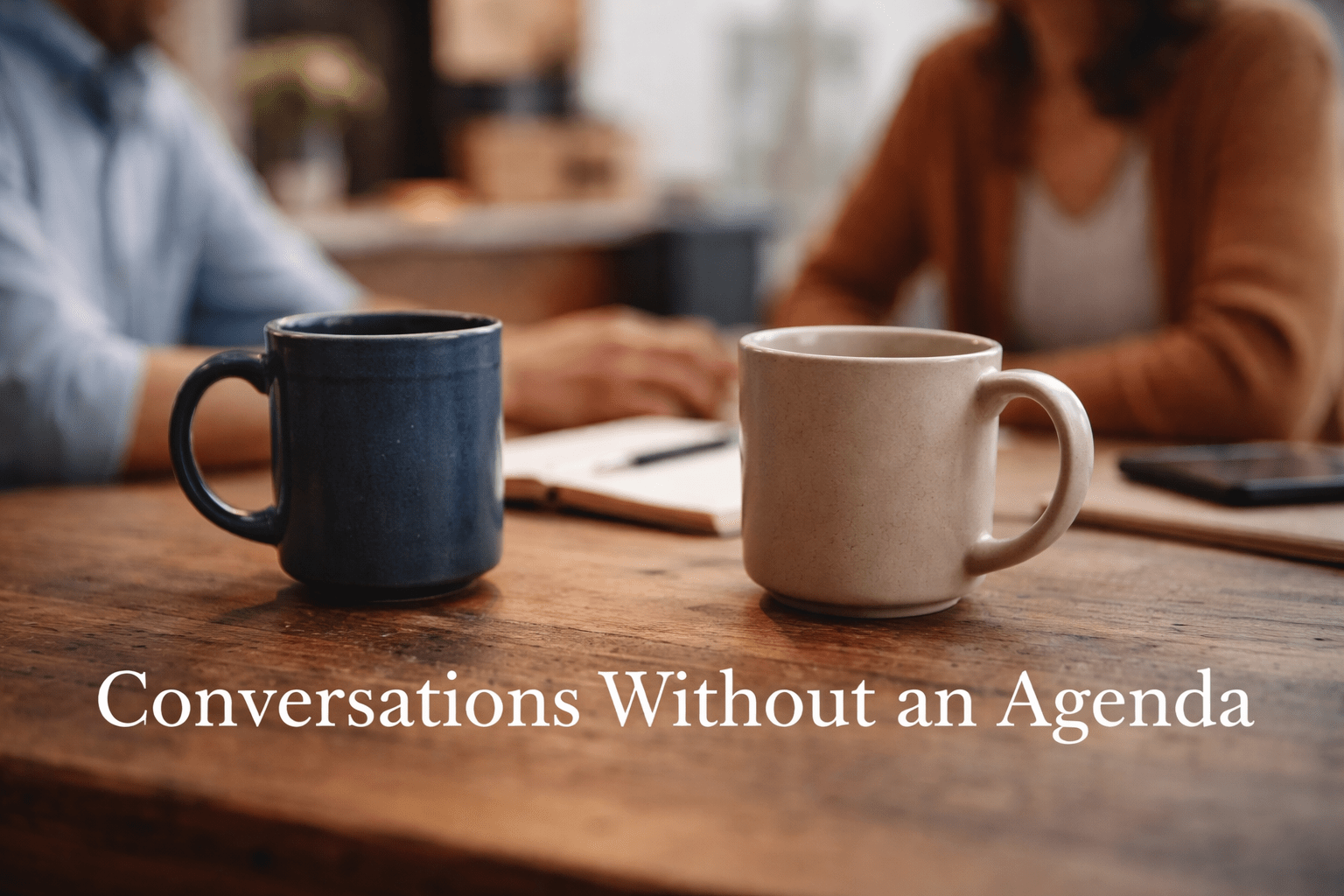
Conversations Without an Agenda
Over the past years, I have spent a great deal of time working with technology and IT. Often in environments where systems were not carefully designed upfront, but gradually evolved over time. Organizations that grew, changed, adapted — and where technology usually tried to catch up afterward.
What has increasingly caught my interest is not the technology itself, but everything surrounding it. How decisions are made. How information flows — or doesn’t. And how people within organizations deal with complexity that was never explicitly planned that way.
Many issues that are later labeled as “technical problems” are not technical at their core. They are the result of choices that made sense at the time they were made, but started to create friction as circumstances changed. Not because someone made mistakes, but because organizations are living systems.
I find value in talking with organizations about this kind of dynamic. Not to provide solutions, not to sell systems, and not to think from a fixed framework. But to understand how things have grown into what they are today.
Conversations without an agenda often lead to the most meaningful insights. When there is no immediate expectation, space emerges to honestly look at what works, what drains energy, and what may have been accepted as “normal” for far too long.
My interest lies at the intersection of technology, processes, and people. Not because I believe everything needs improvement, but because I often see that many things work well — just not always in alignment. And alignment rarely happens by itself.
At this moment, my primary motivation is curiosity. Curiosity about how organizations in Suriname deal with growth, change, and technology. About the stories behind the organization. About decisions made in the past that have shaped today’s reality.
Not with a role or assignment in mind. Simply from the belief that a good conversation can already bring clarity.
Sometimes value does not begin with a solution, but with attention.
Parts of this article were shaped with the help of AI, used as a tool to structure and refine thoughts.